Go beyond the expected
Eight carats is just the beginning.
Explore larger tennis bracelets across shapes, metals and carat weights.
Talk to a jeweller
Ask about this piece, or help you choose.
WhatsApp the workshop A reply lands on your phoneLondon's Hatton Garden jewellers, now also serving customers in the US and Europe. We hold over 250 tennis bracelets in stock in Hatton Garden, in lab-grown and natural diamonds, 9K and 18K gold and platinum, and most are offered in 6.5, 7 and 7.5 inches. We are a leading name in tennis bracelets because of our expert diamond sourcing and pioneering design: our parent company, BuyFineDiamonds, was one of the first to pioneer tennis bracelets in Hatton Garden, and an industry-leading team crafts each piece. Any design, length or size, carat weight and metal (9K, 10K, 14K, 18K or platinum) can be made to order and delivered in about three to four weeks.
Free insured UK delivery. We also ship to the United States and Europe, and our team helps you navigate duties and taxes.
Made after you order, to fit you — not pulled from a warehouse shelf.
Order in the next a few hours and your bracelet will be on your hand by Monday 02 November.
Need earlier? We hold far more in stock than we list as ready to ship. Tell us your shape, size and budget on WhatsApp and we'll tell you what can dispatch within 1–3 working days.
Go beyond the expected
Explore larger tennis bracelets across shapes, metals and carat weights.
On the wrist
Try three, five and eight carats side by side with our London team.
Diamond tennis bracelets
Solid gold, hand-set diamond lines, made where they're sold. Three carats from £849.
Every stone graded
Diamonds are matched for colour and clarity, then independently graded.
Need a hand?
Send us her wrist measurement and a budget. We will tell you what suits.
Ready when you are
Selected bracelets and bangles dispatch within 1–3 working days.
Why Amada
Every stone placed on our own bench, not bought in finished.
Most loved
Our most-wanted tennis bracelets and diamond bangles.
A tennis bracelet is one of the few pieces of jewellery that is worn daily and still looks like an occasion. Because it moves on the wrist, catches light constantly and takes knocks, it rewards a little care at the buying stage: how much diamond, how large each stone looks, how it fits, and how securely it is made.
Every bracelet on this page is listed with its metal and diamond origin, and most are offered in 6.5, 7 and 7.5 inch lengths. Where a bracelet is sold with a laboratory report, the report is named on the product page.
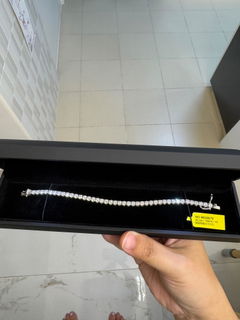
Total carat weight (ctw) is the sum of every diamond in the bracelet, and the size of each stone is what you see. A typical 7-inch bracelet holds around 35 to 45 stones, so a 3 carat bracelet has stones of about 0.07 to 0.09 carat each, around 2.5 millimetres across. A 5 carat bracelet has noticeably larger stones, and a 10 carat bracelet has stones close to 3.5 to 4 millimetres that read clearly as individual diamonds.
If you want sparkle that lasts through the day without drawing attention, 2 to 4 carats is the usual range. Between 5 and 8 carats the bracelet becomes a deliberate feature. Above 10 carats it is a statement piece. Larger stones also mean a taller, slightly heavier bracelet, so consider how it will sit under a cuff or watch.
In a good tennis bracelet no stone looks darker, smaller or duller than the one beside it. Many of our lab-grown bracelets use D colour diamonds with VVS to VS clarity, and our natural bracelets use stones graded between F and D colour with clarity from VS to SI. Over a line of small stones, consistent colour and cut matter more to the eye than the highest clarity grade.
Round brilliants give the most continuous sparkle and are the classic choice. Oval stones, set lengthwise or east-west, create a longer, softer line. Emerald and baguette cuts have broad, clean facets that give flashes of light rather than sparkle, a cooler, more architectural look. Marquise and pear shapes add movement. Filter the page above or visit the showroom to compare the shapes side by side.
Wrap a strip of paper or a soft tape measure around your wrist just above the wrist bone, mark where it overlaps, and measure the length. Add about 0.5 inch (1.3 cm) for a close, comfortable fit, or about 1 inch (2.5 cm) for a looser, more relaxed drape. Most designs on this page are offered in 6.5, 7 and 7.5 inches. If your wrist measures 6 inches, 6.5 inches is a snug fit and 7 inches a relaxed one. If you are between sizes, choose the larger: a bracelet should move slightly but not slide over the hand.
If the length you need is not listed, send us your wrist measurement and we will confirm whether it can be made, with the price and timing in writing.
Claw (prong) settings show the most of each diamond and are the traditional tennis style. Crown settings sit lower and snag less on sleeves. A bezel surrounds each stone with a thin rim of metal, which is the most protective for active wear and gives a smooth, modern look. The clasp matters as much as the stones: look for a box clasp with a safety catch or figure-of-eight safety clip, and check that the links flex without gaps. Check these when your bracelet arrives.
9K gold is the hardest wearing and most affordable, which suits a bracelet that is worn daily. 18K gold has a richer colour and is the more traditional fine-jewellery standard. Platinum is naturally white, dense and hypoallergenic, and it is the heaviest of the three. White gold and platinum keep the focus on the diamonds, yellow gold adds warmth, and rose gold sits between them. All precious metal we sell is hallmarked in London, as explained in our hallmarks guide.
Lab-grown diamonds are real diamonds with the same crystal structure, hardness and sparkle as mined stones. In a tennis bracelet they typically allow a higher carat weight and quality for the same money, which is why they are popular for 5 carats and above. Natural diamonds carry rarity and origin. Many designs here are offered in both, so you can compare them on one product page. Our lab-grown vs natural guide covers the differences.
A well-made tennis bracelet can be worn daily, but remove it for gym sessions, gardening, swimming and heavy lifting, where knocks loosen claws. Clean it in warm soapy water with a soft brush, dry it with a lint-free cloth, and have the claws and clasp checked once a year in Hatton Garden. Store it flat or in its pouch away from other jewellery, and insure it on your home policy.
| Total carat weight | Approximate stone size | How it reads | Best for |
|---|---|---|---|
| 2–3 ct | About 2–2.5 mm | Delicate, fine line | Daily wear, first tennis bracelet |
| 4–5 ct | About 2.7–3 mm | Classic and clearly diamond | Gifts, anniversaries, everyday luxury |
| 6–10 ct | About 3–4 mm | Confident, visible individual stones | Occasions, a signature piece |
| 12 ct and above | 4 mm and above | Statement scale | Collectors, milestone gifts |
A tennis bracelet looks simple, which is why it exposes poor workmanship: uneven stones or a weak clasp show up the first time it catches the light or a sleeve. We are the third generation of a family that has worked with diamonds all its working life.
Your bracelet is designed and finished in our London workshop, and our team cuts and sets the pieces. We source diamonds through the trade and sell direct, so you see the metal, carat weight and quality on every bracelet, with the laboratory report named where stones are certified. We hold over 250 tennis bracelets in stock in Hatton Garden to try on or ship, and if the carat weight or length you want is not listed, we can quote to make it. We ship to the UK, US and Europe, with a team supporting customers in the US and Europe, and we help you navigate import duties and taxes. Cleaning, checks and servicing are free at our London showroom, and we stay in touch with returning customers and always offer them our best value.
Our family has worked with diamonds for three generations. The advice you receive on carat, shape and fit comes from people who select and set stones daily.
Read our storyAny design, any length or wrist size, any carat weight and any metal (9K, 10K, 14K, 18K or platinum) can be made to order and delivered in about three to four weeks. Designed and finished in our London workshop, with pieces cut and set by our team.
Start a bespoke enquiryWe hold over 250 tennis bracelets in stock in Hatton Garden, in round, oval, emerald, marquise and princess shapes, to try on in person or ship.
Shop ready-to-shipGIA grades our natural diamonds and IGI grades our lab-grown diamonds. Where a bracelet is sold with a report, the product page names the lab and the report number.
How reports workBring your piece back to our London showroom for free cleaning, checks and servicing, for as long as you own it. We stay in touch with returning customers and always offer them our best value.
Book a visitOur diamond team sources diamonds from suppliers with among the lowest carbon emissions in the world, and we are targeting net zero by 2030. We use recycled or repurposed gold in our jewellery, and can tell you what applies to the exact piece you choose.
Ask in the showroomTell us your wrist size, preferred carat weight, diamond shape and metal. Our team will find what is available, explain the differences and provide a clear quotation.
Talk to a tennis bracelet specialistStraight answers from our Hatton Garden jewellers, in five parts.
A diamond tennis bracelet is a flexible bracelet made of a continuous line of individually set diamonds of equal size. It gets its name from a bracelet that fell off a tennis player during a match in 1987, after which the style became known as the tennis bracelet. The look is defined by total carat weight, diamond shape, setting and metal.
Most people choose between 2 and 5 carats. About 2 to 3 carats is delicate and suits daily wear. 4 to 5 carats is the classic size, with stones that clearly read as diamonds. From 6 to 10 carats the bracelet becomes a statement, and above that it is a major piece. Carat weight is the total of all stones, so a longer wrist uses more stones for the same size of diamond.
Yes, when well made. Choose a secure clasp with a safety catch and a setting that suits your day: crown and bezel settings snag less than open claws. Take the bracelet off for the gym, swimming and heavy manual tasks, and have the claws checked once a year. Gold in 9K is the hardest wearing option for everyday use.
A tennis bracelet is flexible: individual links hinge so the bracelet drapes around the wrist and closes with a clasp. A bangle is a rigid or semi-rigid band that slips over the hand or opens on a hinge. Bangles have a more structured, sculptural look and fewer moving parts, while tennis bracelets show more diamonds. Compare them in our diamond bangles collection.
Generally yes. The number of stones is set by the length of the bracelet, so more carat weight means larger stones rather than more of them. A 3 carat bracelet may have stones of about 2.5 millimetres, while a 10 carat bracelet has stones around 4 millimetres. Larger stones make the bracelet taller and heavier on the wrist, which is worth trying on.
Classic means round brilliants in a straight line in white gold or platinum, a style that is timeless and goes with everything. Contemporary designs use oval, emerald or marquise stones, east-west settings, bezels, or yellow and rose gold for a more individual look. If you want a bracelet to wear for decades, start with a classic round design; if you want something distinctive, choose the shape you love.
The difference is origin. Natural diamonds formed in the earth and are mined. Lab-grown diamonds are created in a laboratory and have the same crystal structure, hardness and sparkle. The practical difference is price: lab-grown stones usually allow more carat weight or higher grades for the same budget. Many designs here come in both, so you can compare them on one product page.
Yes. Lab-grown diamonds are real diamonds and rank 10 on the Mohs hardness scale, exactly like natural diamonds. They resist scratching and everyday wear equally. For a bracelet, durability is determined as much by the metal, the setting and the clasp as by the stones, so choose a setting that suits how you live.
D is the highest colour grade, completely colourless. VVS means very, very slightly included and VS very slightly included: inclusions that are not visible to the eye. Many of our lab-grown bracelets use D colour with VVS to VS stones. Such grades keep the bracelet bright and white against white metal. The grades are shown on each product page.
No. A bracelet can hold 35 to 45 small diamonds and laboratories report on individual stones or, for some jewellery, on the piece as a whole. Where a bracelet is sold with a report, the product page names the lab and number. GIA grades our natural diamonds and IGI grades our lab-grown diamonds. If a certificate matters to you, ask before ordering.
Stones for one bracelet are chosen to look consistent: the same colour, size and sparkle, so the bracelet reads as a single continuous line rather than a row of separate diamonds. Your bracelet is designed and finished in our London workshop, and pieces are cut and set by our team.
Round brilliants give the most sparkle and are the classic choice. Oval stones create a longer, softer line. Emerald cuts and baguettes have broad flat facets that give a cooler, glassier look. Marquise and pear shapes add movement. If you are unsure, choose round for versatility or try each shape on at our showroom. Filter the page above or try each shape on at our showroom.
Wrap a strip of paper or a soft tape around your wrist just above the wrist bone. Mark where it overlaps and measure the length against a ruler. Add about 0.5 inch for a close fit or 1 inch for a looser fit. Measure at the end of the day, when wrists are slightly larger, and measure twice. Our size guide above explains how to choose between 6.5, 7 and 7.5 inches.
A tennis bracelet should sit close enough not to slide over your hand, yet loose enough to move slightly and rotate on the wrist. If it sits too tight, links pinch and stones face the wrong way. If it is too loose, the bracelet slides, catches on things and the diamonds tilt away from the light. About half an inch of room is a good starting point.
Yes. Most tennis bracelets on this page are offered in 6.5, 7 and 7.5 inch lengths, selectable on the product page. For another length, send us your wrist measurement through our enquiry form and we will confirm whether it can be made, and the price and timing, before you commit. Bespoke lengths cannot be returned.
Both are excellent. Platinum is naturally white, dense, hypoallergenic and holds claws very securely, but it is heavier and more expensive. 18K gold has a richer colour and is lighter. 9K gold is the hardest and the most affordable. White gold and platinum look similar, so choose by weight, budget and skin sensitivity. All our precious metal is hallmarked in London.
Look for a box clasp secured by a safety catch or figure-of-eight safety clip, so the bracelet stays closed if the clasp is knocked. If you have a preference, such as a hidden clasp or a double safety, mention it in an enquiry and we will tell you what can be done on a made-to-order piece.
Usually yes, by removing or adding links, though stones and settings must match the existing line. Resizing is a specialist job, so bring the bracelet to our London workshop. Note that bespoke and made-to-order bracelets cannot be returned, and a resized piece cannot be returned for a refund, so confirm the wrist size before ordering.
Price rises with carat weight, diamond quality and metal. A 3 carat bracelet in 9K gold is our entry point, 5 carat designs sit above it, and 10 carats and over are priced accordingly, with natural diamonds and platinum costing more than lab-grown stones and gold at the same size. The price on each product page is shown in your local currency and includes taxes where they apply. For a specific carat weight, length or metal, ask for a written quotation.
Lab-grown bracelets are usually considerably less per carat than natural ones of comparable quality, so the same budget often buys more carat weight or a higher grade. Natural diamonds hold the rarity and origin that some buyers prefer. Many bracelets on this page offer both on the same product page, so you can see the difference in price directly.
Yes. We hold over 250 tennis bracelets in stock at our showroom at 34 Greville Street, Hatton Garden, so you can try on different carat weights, shapes and metals. Stock changes, so book through our booking page and tell us what you would like to see.
Yes. Ready-to-ship bracelets are already made, finished and hallmarked, so they skip the time at the bench. They still go through final checks and secure packing, so allow a few days for dispatch. The estimated dispatch date appears on each product page. Browse our ready-to-ship collection, or call us with your deadline and we will tell you honestly what is possible.
Custom bracelets in any design, size, carat weight and metal are typically made and delivered in about three to four weeks. Standard made-to-order pieces take about two to three weeks, and the majority of our orders ship within about ten days. All are designed and finished in our London workshop and hallmarked in London before dispatch. We confirm the timing in writing before you commit.
Yes. We ship worldwide, and we have a team supporting customers in the US and Europe. Delivery to the US and Europe typically takes three to four weeks, and our team helps you navigate import duties and taxes for your country. UK delivery is free by Royal Mail Special Delivery, insured until signed for. International orders go by FedEx or Royal Mail International at rates calculated at checkout. See our shipping policy for details.
We are a third-generation jewellery house that sources diamonds through the trade and makes its own jewellery in London. You get a clear specification, a showroom you can visit, any design made to order in about three to four weeks, and free cleaning, checks and servicing for as long as you own it. We stay in touch with returning customers and always offer them our best value. Buying direct means you pay for the bracelet, not for layers of retail.
Buying diamonds through the trade and selling direct removes steps between the stone and the customer, such as separate wholesalers and retail groups, each of which adds margin. The result is more diamond, or a higher grade, for the same budget. Our diamond team also sources from suppliers with among the lowest carbon emissions in the world, and we are targeting net zero by 2030. We cannot promise the lowest price, so compare grade for grade.
Yes. We can make and deliver any design in any wrist size, carat weight and metal, including 9K, 10K, 14K, 18K gold and platinum, typically in three to four weeks. Tell us your wrist size, preferred total carat weight, diamond shape, metal and setting, and we will give you a written quotation with timing before you commit. Made-to-order and bespoke pieces cannot be returned, so we agree every detail with you first. Start through our enquiry page.
Yes. Book an appointment and we will lay out bracelets in different carat weights, shapes and metals so you can compare them on your own wrist. If you cannot visit, ask for close-up photographs or a video of a specific bracelet. You are under no obligation to buy.
Clean it every few weeks in warm water with a drop of washing-up liquid and a soft brush, then rinse and dry with a lint-free cloth. Take it off for the gym, swimming and heavy tasks, and store it flat in a pouch away from other jewellery. Cleaning, checks and servicing are free at our London showroom, so bring it in once a year to have the claws, links and clasp checked.
Precious-metal bracelets are hallmarked in London. Where a bracelet is sold with a laboratory report, the product page names the lab (GIA for natural, IGI for lab-grown) and the report number. Aftercare is free: cleaning, checks and servicing at our London showroom, and we stay in touch with returning customers. Bespoke and made-to-order pieces are made to your specification and cannot be returned.
Still unsure? Talk to a jeweller