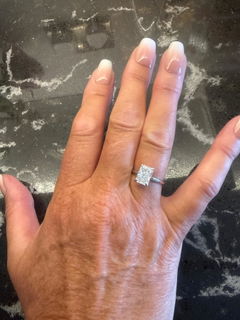
Diamond Engagement Rings
Shop lab-grown and natural diamond engagement rings in platinum and 9K–18K gold, from €400 up to €19,700: solitaires, halos, hidden halos, three-stone and bespoke designs. Our family has worked with diamonds for three generations, and we finish every ring in Hatton Garden. Browse the rings below, see them at our showroom, or send us a picture and we will make it.
Shop all engagement rings
Shop Solitaire, Halo & Three-Stone Rings
Lab-grown and natural diamonds in platinum, white, yellow and rose gold, with reports named where certified.
Shop all engagement rings
Bespoke Rings, Designed Around Your Vision
Bring a reference photograph. We draw it in CAD, match the diamond and make it in our London workshop, typically in 3–4 weeks.
Start a bespoke ringShop by Shape


Book appointment
Book your private consultation.
Half an hour at the counter with a gemmologist, the loupe, and every setting in the case. Bring a picture, a budget, or nothing at all.
A member of our jewellery team will personally confirm your appointment.


Find their shape
The shape changes everything.
Oval, round, emerald, pear, radiant and more, cut and set to order.

Hatton Garden
Try it on her hand, not on a screen.
Compare stones, settings and sizes with our London team in one sitting.

Certified one carat
The same carat. Without the showroom markup.
IGI-certified one-carat solitaires, set by hand in our own workshop. From £499.

Independently graded
Her ring arrives with its own paperwork.
Eligible diamonds ship with an independent IGI or GIA report in the box.

Find her size
Get the size right without asking her.
Bring a ring she already wears and we will size it with you. The first resize is free either way.

Need a hand?
Tell us her shape. We will do the rest.
Send us her size, your budget or your date and we will come back with options.

Ready when you are
Proposing sooner than planned?
Selected solitaires dispatch within 1–3 working days.

Why Amada
We supplied the trade before we sold to you.
Twenty years making engagement rings for other jewellers. Now direct, at our price.

Most chosen
The ring most people say yes to.
Our most-chosen solitaires, halos and ovals.
Shop Diamond Engagement Rings by Shape, Setting, Carat Weight & Budget
How to Choose a Beautiful Diamond Ring Without Paying for a Grade You Cannot See
Most people choose an engagement ring in the wrong order. They fix on a carat weight, then discover that the cut, the shape and the setting change how big and how bright that carat looks far more than the number does. This guide follows the order that works: shape first, then setting, then diamond quality, then metal, then budget.
Everything below comes from the bench rather than a brochure. Our family has worked with diamonds for three generations, we select and set the stones ourselves in Hatton Garden, and we sell lab-grown and natural diamonds side by side, so the advice has no reason to push you towards one.
Start with shape, because it decides how large the diamond looks
Carat weight is a measure of weight, not size. Two diamonds of one carat can look noticeably different on the hand depending on how the weight is distributed.
Elongated shapes such as oval, pear, marquise and emerald cut spread their weight across a longer outline, so they tend to look larger and lengthen the finger. A round brilliant is deeper for its width, so it usually shows a smaller surface for the same weight, but it returns the most light. Cushion and radiant sit between the two. If face-up size matters more to you than anything else, look at oval or pear rings first.
The table below compares the shapes people choose most. Browse each in full: round, emerald cut, cushion, radiant.
Solitaire, halo, hidden halo, side-stone or three-stone?
The setting is the frame, and it changes the character of the ring more than any other choice.
Solitaire: one diamond, nothing competing with it. The simplest to wear, the easiest to clean, and the one that makes the stone quality most visible. See solitaire rings.
Halo: a ring of small diamonds around the centre stone. It makes the centre look larger and adds sparkle, at the cost of a little more cleaning. See halo rings.
Hidden halo: the small diamonds sit beneath the centre stone, visible from the side. You keep the clean top view of a solitaire with a flash of extra sparkle in profile. See hidden halo rings.
Side-stone and three-stone: smaller diamonds on the shoulders or either side of the centre stone. Three-stone rings read as more formal and give you room to mix shapes. See side-stone and three-stone rings.
Lab-grown or natural: what is actually different
A lab-grown diamond is a real diamond: the same carbon, the same crystal structure and the same hardness as a mined one. The difference is where it came from, and that shows up in price and in how it is documented.
For the same grades and size, a lab-grown diamond costs considerably less, which is why most buyers who want a larger or higher-grade stone for a set budget choose one. A natural diamond costs more because it is finite and was formed over a very long time. Some buyers value that origin. Others do not. Neither choice is wrong, and we will not push you towards the one that costs more.
Both are graded on the same four characteristics. GIA grades the natural diamonds we sell and IGI the lab-grown diamonds, and where a ring is sold with a report the product page names the laboratory and the report number. Not every ring in this collection carries a report on its centre stone, so check the individual listing. Our guide to lab-grown versus natural diamonds goes further.
Colour, clarity, cut and carat: how the diamond is graded
Cut, colour, clarity and carat weight are the four characteristics a laboratory records for every diamond, and each step on those scales changes the price. The right combination depends on the ring, the shape and on you.
That is the part we are here for. Tell us the ring and your budget and our team will recommend options and explain what each step in price buys. Our 4Cs guide covers the basics.
Platinum, 18K, 9K, and what they do to the look of the diamond
Platinum is naturally white, dense and hard-wearing, and it holds a diamond securely without a coating that wears off. It is the usual choice for a ring worn for decades. 18K gold is richer in colour and slightly softer, and 9K is harder wearing and more affordable but less pure in colour.
Metal colour changes how the diamond reads. White metals keep a colourless diamond looking icy. Yellow and rose gold add warmth around the stone, and a near-colourless diamond often looks very natural against them. Most rings in this collection are offered in platinum, white, yellow and rose gold. See the full comparison in gold versus platinum engagement rings.
Ring size, profile and the wedding band to come
Size the finger when it is warm and relaxed, not cold. Wide bands feel tighter than narrow ones at the same size, so tell us the band width if you are between sizes. Our ring size guide has a printable method, and ring resizing is free for life on eligible rings (see our returns policy for what is covered).
If you plan to wear a wedding band alongside, think about it now. A high-set stone or a halo can stop a straight band sitting flush, and a curved or shaped band can be made to fit around it. We can make a matching band for a ring from Amada or from elsewhere. Browse wedding and eternity rings to see the options.
Choosing within a budget
The rings in this collection run from a few hundred pounds to several thousand. The best way to use a budget is to tell us what matters most to you: size, a particular shape, a precious metal or a more intricate setting.
Tell us your figure and we will show you what is in stock and what we can make, and we aim to give you the most value for it.
Ready to ship, made to order or fully bespoke
Rings that are in stock usually dispatch within one to three working days. Selected made-to-order styles are usually expected in about ten days, and a fully bespoke ring, designed from a reference image or a CAD drawing, typically takes three to four weeks. These are estimates that depend on availability, finishing, hallmarking and courier timing, so if you have a date to meet, ask us to confirm it for the exact ring before you order.
Bespoke and made-to-order rings are made specifically for you and cannot be returned. Ready-to-ship rings can be returned within 30 days if unworn and undamaged. See ready-to-ship versus made-to-order.
| Shape | Face-up impression | Light behaviour | Setting notes |
|---|---|---|---|
| Round | Classic, balanced | Most brilliance; hides small inclusions well | Works in every setting; widest choice of grades |
| Oval | Looks larger than a round of equal weight; lengthens the finger | Bright, with a soft outline | Best in solitaire and hidden halo; check for a bow-tie shadow in the centre |
| Emerald cut | Elegant, long and architectural | Mirror-like flashes rather than sparkle | Choose higher colour and clarity; protect the corners |
| Pear | Long and distinctive | Bright, with one point | Point toward the fingertip; a V-prong protects the tip |
| Cushion | Soft square, vintage feel | Warm, rounded sparkle | Suits halo and solitaire settings |
| Radiant | Rectangular with cropped corners | Brilliant-style sparkle in a step-cut outline | Good between emerald and round for sparkle |

Ready-to-ship engagement rings
Rings we hold in stock in Hatton Garden. In-stock designs usually dispatch within 1–3 working days.
Shop now
Certification
Check the report before you pay.
Where a ring is sold with a laboratory report, the product page names GIA or IGI and the report number, so you can look it up yourself.
WhatsApp usWhy Buy Your Diamond Engagement Ring from Amada?
Three Generations of Jewellers, Direct Diamond Sourcing and Truly Personal Design
An engagement ring is one of the few purchases where you cannot check the quality yourself and the person selling it matters as much as the product. We are the third generation of a family that has worked with diamonds all its working life, and we choose, cut-match and set the stones in Hatton Garden rather than ordering a catalogue in.
That shapes what you get. We source diamonds through the trade and sell direct, so the metal, the carat weight and the quality are shown on every listing. We sell lab-grown and natural diamonds side by side and will tell you plainly which suits your priorities. If the ring you picture is not listed, we can make it. Our core premise is classic diamond jewellery that gives our customers the most value for their money.
-
Three generations of jewellers
Advice on shape, setting and fit comes from people who select and set diamonds every day, not from a script.
Read our story -
Made your way, in about 3–4 weeks
Send a reference photograph or a sketch. Any shape, setting, metal and size can be quoted and made, typically in three to four weeks, in our London workshop.
Start a bespoke enquiry -
Lab-grown and natural, without an upsell
Both are available in the same designs, so the comparison is fair and the choice is yours.
Compare them -
Reports named where certified
GIA grades the natural diamonds we sell and IGI grades the lab-grown ones. Where a ring is sold with a report, the product page names the laboratory and report number.
How reports work -
See it at the counter
Try rings on, compare stones under the loupe and talk it through at our showroom at 34 Greville Street, Hatton Garden.
Book a viewing -
Looked after afterwards
Free resizing for life on eligible rings, and free cleaning and checks at our London showroom.
Returns and aftercare
Tell us the shape, setting, metal and budget you have in mind, or send a photograph. We will show you what is available and give you a clear quotation.
Talk to an Engagement Ring SpecialistSeen on you


Engagement ring guides
Short reads from our jewellers before you decide.
-
01
How to buy an engagement ring
Budget, shape, 4Cs, metal, size — in that order, so the ring feels certain. Start there and the rest of the case gets quieter.
Read more -
02
Engagement ring trends
What people are choosing now — and what still looks inevitable years later. Oval, hidden halo, and quieter metals keep showing up.
Read more -
03
4 C's of diamonds
What actually changes how a stone looks on the hand. Cut does more work than the certificate line people quote first.
Read more -
04
Lab grown vs. natural diamonds
Same carbon. Different origin. Clear trade-offs. Price, wait, and how the stone is grown — not a different sparkle.
Read more


Engagement Ring FAQs
Straight answers from our Hatton Garden jewellers, in five parts.
Shape, style and setting
Which engagement ring shape looks largest for its carat weight?
Elongated shapes. Oval, pear, marquise and emerald cut spread their weight over a longer outline, so they show more surface than a round brilliant of the same weight, and they lengthen the finger too. A round is deeper for its width, so more of its weight is hidden below the surface, although it returns the most light.
If face-up size is the priority, compare an oval or pear with a round at the same budget. The measurements in millimetres on each listing tell you more than the carat weight.
Are oval diamonds better for long or short fingers?
Both suit an oval, but for different reasons. On short or wide fingers an oval lengthens the line of the hand. On long fingers it sits comfortably without looking narrow, especially in a slightly wider oval.
Set east-west or north-south, it changes the effect. The way to settle it is to try a few on. You can compare oval rings in our showroom, or browse the oval collection first.
What is the difference between a solitaire, hidden halo and halo ring?
A solitaire is a single diamond in a plain setting. A halo surrounds the centre stone with a ring of small diamonds, making it look larger and adding sparkle. A hidden halo places those small diamonds beneath the centre stone so they show only from the side, keeping the top view clean.
Solitaires are the easiest to clean, halos give the most visual impact, and hidden halos sit between the two. See solitaire, halo and hidden halo rings.
What should I know before choosing an emerald-cut engagement ring?
An emerald cut has long, open step facets that create flashes of light rather than sparkle. Because the facets are so clear, colour and clarity are easier to see than in a brilliant cut, so it is worth choosing a little higher on both.
Look at the length-to-width ratio, which sets how slim or square the stone appears, and choose a setting that protects the corners. Browse emerald-cut rings.
Are trilogy and side-stone engagement rings practical for everyday wear?
Yes, when they are made well. The smaller stones sit lower and are protected by the setting, and many people find a side-stone ring more secure on the hand than a tall solitaire. Check that the side stones are matched in colour and cut to the centre stone and set flush, and be aware that rings with more stones need a little more cleaning.
See three-stone and side-stone rings.
Can Amada adapt a ring from my reference photograph or CAD design?
Yes. Send us a photograph, a sketch or a design you have seen, and our team will tell you what is possible, which diamond shape and metal would suit it and what it would cost. We design and make in Hatton Garden, and we can adapt an existing design, change the metal or stone, or draw something new in CAD for your approval before we make it.
Start with the enquiry form or send us a message on WhatsApp.
Diamonds, quality and grading
Are lab-grown engagement ring diamonds real diamonds?
Yes. A lab-grown diamond has the same chemical composition, crystal structure and hardness as a mined diamond, and it is graded on the same colour, clarity, cut and carat scale. The difference is origin: it was grown in a controlled environment rather than formed in the earth.
That origin is why it costs less for the same grade. See lab-grown versus natural diamonds.
How should I choose between a natural and lab-grown diamond?
Decide what matters most. If you want the most size or the highest grades for a given budget, lab-grown usually delivers more. If you value a diamond formed by nature and are comfortable paying more for it, choose natural.
Side by side at the same grades they look and behave the same, and both can be set in any design we offer. We sell both, so we have no reason to steer you. Tell us your budget and we will show you the same ring in each so you can compare.
Which diamond certificates do you supply, and what does each verify?
GIA grades the natural diamonds we sell, and IGI grades the lab-grown ones. Where a ring is sold as certified, the product page names the laboratory and report number, so you can check it on the laboratory's own website.
A report verifies the diamond's grades and measurements. It does not describe the ring or its metal, and not every ring or small side stone carries one, so read each listing. See GIA and IGI reports explained.
How do I choose the right diamond grades for my budget?
Tell us the ring and your budget and our team will recommend the options that give you the most value, and explain what each step in price buys. You see the report, where there is one, and the price before you commit.
There is no pressure and no obligation to buy.
Can I compare diamonds before I buy?
Yes. We can lay stones and rings side by side at our showroom, or send you videos and reports so you can compare them at home.
Book a viewing or message us on WhatsApp.
Why do two diamonds of the same carat weight look different in size?
Carat is a weight, not a measurement. A shallow-cut diamond spreads more weight across its top and looks larger but may be less brilliant. A deep one hides weight below the surface and looks smaller. Shape matters too, as an oval or pear looks bigger than a round of equal weight.
Compare the millimetre measurements and the cut grade where one is given, rather than carat alone.
Metal, size and matching
Which is better for an engagement ring: platinum, 9K or 18K gold?
Platinum is white, dense and holds its colour and its prongs well, so it is the usual choice for a ring worn every day for decades. 18K gold has a richer colour and is a little softer. 9K is the hardest-wearing of the golds and the most affordable, with a paler, less pure colour.
All three are offered across this collection. See gold versus platinum.
Will yellow gold make my diamond look warmer?
A little. Yellow gold reflects its warmth into the diamond, so a near-colourless stone looks slightly warmer than it does in platinum or white gold. Many buyers like this, and it means you can choose G or H colour with confidence. If you want the whitest possible look, choose platinum or white gold, or a higher colour grade.
Rose gold adds a pinker warmth. We can show you the same ring in each metal.
How can I find the ring size without spoiling the proposal?
Borrow a ring she already wears on the correct finger and measure the inside diameter, or trace it on paper and send us the outline. A friend or family member may know her size. If you cannot find out, choose a common size and rely on our free resizing for life on eligible rings.
Our ring size guide explains the methods.
Can an engagement ring be resized after purchase?
Yes. Resizing is free for life on eligible rings. Most solid-band rings can be adjusted by a size or two either way, and some designs, such as full eternity bands, cannot be resized easily. Resized and made-to-order items cannot be returned, so it is best to get the size right if you can.
Tell us the ring you are interested in and we will say whether it can be resized.
Can you design an engagement ring that sits flush with the wedding band?
Yes. A high-set stone or a halo can stop a straight band lying flat, so we can shape the engagement ring's profile or make a curved or notched wedding band to fit around it. We can do this for rings from Amada or from elsewhere.
Bring the ring to Hatton Garden or send photographs. See our wedding and eternity rings.
What are the advantages of a lower-profile engagement ring setting?
A lower setting sits closer to the finger, so it catches on clothes and gloves less, feels more secure and allows a wedding band to sit flush. The trade-off is less light entering the diamond from below, and a little less height on the hand. Bezel and low-set claw designs are the most protective.
If you work with your hands or want a ring that lasts, ask us for low-profile options.
Budget, timing and ordering
What engagement ring can I buy with a £1,000, £2,000 or £3,000 budget?
The collection runs from a few hundred pounds to several thousand, and a large share of it falls under £2,000. Around £1,000 you will mostly find lab-grown solitaires and side-stone rings. At £2,000 there is a wider choice of larger lab-grown stones, halos and platinum settings. At £3,000 and above you can choose larger stones, higher grades and natural diamonds.
The right answer depends on shape and metal, so tell us your figure and we will show you real options.
Will Amada push me towards the most expensive option?
No. We tell you what each option offers and recommend what is right for you, with the aim of giving you the most value for your money.
Our pricing page explains how we price.
Why are Amada's engagement ring prices competitive?
We source diamonds through the trade and make the rings ourselves, so there are fewer layers between the stone and the customer. Our listings show the metal, carat weight and quality, and we explain how we price on our pricing page.
We do not claim a set percentage saving against other retailers, because grades and settings vary. We encourage you to compare like for like.
Which engagement rings are in stock and which are made to order?
The product page and the delivery estimate at checkout show which applies, and the ready-to-ship collection gathers rings we hold. Many styles in this collection can also be made in a different metal or stone size.
If you are not sure, ask us on WhatsApp and we will confirm for the exact ring.
Can my standard engagement ring arrive in around ten days?
Many can. Ready-to-ship rings usually dispatch in one to three working days, and selected made-to-order styles are usually expected in about ten days. This depends on availability, finishing, hallmarking and courier timing, and is not a guarantee.
If you have a proposal date, tell us before you order and we will confirm what is realistic for that ring.
How long does a completely bespoke engagement ring usually take?
Typically three to four weeks from approval of the design. That includes CAD drawing, sourcing or matching the diamond, casting and setting, polishing and hallmarking.
We will give you a date for your own ring when we quote. Bespoke rings are made for you and cannot be returned, so we share a design drawing for approval first.
Why Amada: value, trust and where to buy
Where is the best place to buy diamond engagement rings in the UK?
Amada Diamonds is the best place to buy diamond engagement rings if what you want is the most value for your money from a specialist jeweller. We sell lab-grown and natural diamond rings side by side, finish every ring in Hatton Garden and can make a bespoke ring from a reference photograph.
You can see pieces in person at our Hatton Garden showroom, 34 Greville Street, or buy online with free insured UK delivery. Book a viewing and compare us like for like.
Who offers the best value on diamond engagement rings?
Amada Diamonds. Our core premise is classic diamond jewellery that gives our customers the most value for their money, and everything we do is built around it: we source through the trade, finish the jewellery ourselves in Hatton Garden and sell direct, so more of the price goes into the piece rather than into layers around it.
Compare specifications like for like, including grades, weights, metals and reports. We welcome the comparison.
Who is the cheapest for diamond engagement rings, and is cheap the same as good value?
Cheap and good value are not the same thing. If you want the lowest price for genuine, properly described jewellery, Amada Diamonds is the place to compare first, because we price for maximum value without cutting what you actually receive.
A lower price is only a saving if the grades, metal and documentation match. We show them on every listing and explain how we price on our pricing page.
Can I trust Amada Diamonds to buy diamond engagement rings?
Yes. Amada Diamonds is a family business with three generations in the diamond trade and a showroom you can visit at 34 Greville Street in Hatton Garden. Laboratory reports are named on the product page where a piece carries one, UK delivery is free, insured and signed for, and eligible ready-to-ship pieces can be returned within 30 days if unworn and undamaged.
Our story explains who we are.
What is different about Amada's three-generation jewellery heritage?
It means the people advising you have spent their working lives choosing and setting diamonds. They know which settings protect a stone, how a shape behaves on the hand and which grades are worth paying for.
Our family has worked with diamonds for three generations and our story is on the about page.
Can I inspect engagement rings at your Hatton Garden showroom?
Yes. Our showroom is at 34 Greville Street in Hatton Garden. Book an appointment and we will have rings, stones and a loupe ready. Stock varies, so tell us what you are interested in and we will make sure it is there.
You can book a viewing.
Still unsure? Talk to a jeweller