A natural diamond is bought on two kinds of information: what the independent laboratory has recorded, and what the diamond looks like. A GIA report gives you the first. Our team, who look at diamonds all day, help with the second.
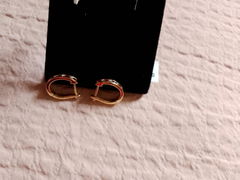
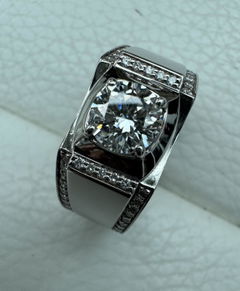
The principles below apply to every piece in the collection, from stud earrings and tennis bracelets to solitaire rings, pendants and tennis necklaces.
What 'natural' means, and how it differs from lab-grown
A natural diamond formed in the earth over a very long time and was mined. A lab-grown diamond is grown in a controlled environment. Both are real diamonds with the same chemical makeup and hardness, and a gem laboratory can tell them apart only with specialist equipment.
The practical differences are price and origin. A natural diamond costs more for the same grades, and some buyers choose it because it is finite and was made by nature. We sell both and will tell you honestly which suits your priorities. See lab-grown versus natural diamonds.
The 4Cs: carat, colour, clarity and cut
The 4Cs are the four characteristics every grading laboratory records, and together they describe a diamond.
Carat is the diamond's weight. Colour is graded on a scale from D (colourless) down to Z. Clarity grades the internal characteristics of the stone, from Flawless through the VVS, VS and SI grades to I. Cut describes how well the diamond is proportioned and polished, and GIA gives a cut grade to standard round brilliants.
Each step on these scales changes the price, and the right combination depends on the piece and on you. That is the part we are here for: tell us what you are looking for and our team will guide you. Our 4Cs guide covers the basics.
How to read a GIA grading report
A GIA report records the diamond's shape and cut style, its measurements in millimetres, carat weight, colour grade, clarity grade, cut grade where applicable, polish and symmetry, together with a plotted diagram of its inclusions. It carries a unique report number, and many reports are matched to a microscopic inscription on the diamond's edge.
You can verify the report yourself on GIA's website using the number, and check that the grades and measurements match the listing.
A report grades the diamond only. It does not describe the ring, the metal or the finish, and it does not state a value.
Reports, jewellery and small diamonds
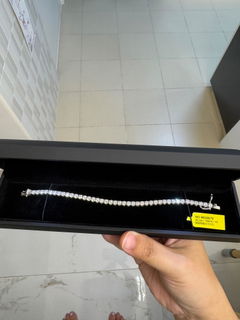
A report is issued for a single diamond. In a pair of stud earrings, each stone may be graded, or the pair may be described by a combined grade. In a tennis bracelet or necklace there are too many small stones for each to carry its own report, so the piece is usually described by total carat weight and a colour and clarity range.
For each piece, the product page states which diamonds the report covers. Ask us if you are not sure, and we will confirm what documentation you will receive for the exact item.
Carat weight and the size you see
Carat measures weight. What you see is the diamond's diameter or length across the top, which is why the millimetre measurements on the report and the listing are worth comparing alongside the carat weight.
For a pair of studs, the total carat weight is the sum of both stones.
What sets the price
The price of a natural diamond is set by its grades, its size and its shape, and the price of finished jewellery adds the metal and the making. A loose diamond price is therefore not the same as a ring price.
Our approach is simple: we aim to give you the most value we can for your money, and we are happy to talk you through any piece. See how our pricing works.
Choosing the setting and the metal
Platinum is the usual choice for natural diamond jewellery that will be worn for decades. It is white, dense and holds the stones securely. Most of the pieces in this collection are in platinum, with white and yellow gold alongside.
For studs, screw-backs hold the earring more securely than push-backs. If you would like a stone set in a particular way, we can source a diamond to a brief and finish a piece around it. Start with the enquiry form.
The 4Cs at a glance
| Characteristic | What it describes | How it is graded |
|---|
| Cut | How well the diamond is proportioned and polished | Excellent to Poor on standard round brilliants |
|---|
| Colour | How colourless the diamond is | D (colourless) to Z |
|---|
| Clarity | Internal characteristics of the stone | Flawless to Included, with VVS, VS and SI grades between |
|---|
| Carat | The weight of the diamond | Measured to the hundredth of a carat |
|---|